


The "Solid-State" Identity Crisis
In the global push toward next-generation energy storage, "solid-state" has become the industry’s North Star. However, a significant gap exists between the marketing label and the electrochemical reality. Solid State Battery Market currently fractured into two compromised architectures that fail to resolve the fundamental "Solid-State Identity Crisis":
Industry Pain Points:
- The "Semi-Solid" Compromise: These are often polymer-based electrolytes plasticized with liquid components. While flexible, they are essentially "gels." They suffer from low ionic conductivity and, crucially, fail to deliver the true non-flammability and thermal safety that defines a genuine solid-state system.
- The "Brittle Ceramic" Barrier: These rigid, ceramic-only electrolytes offer high conductivity but are a manufacturing nightmare. Their extreme fragility leads to poor contact at the electrode interfaces and an inability to survive the rolled or wound form factors required for high-volume gigafactory production.
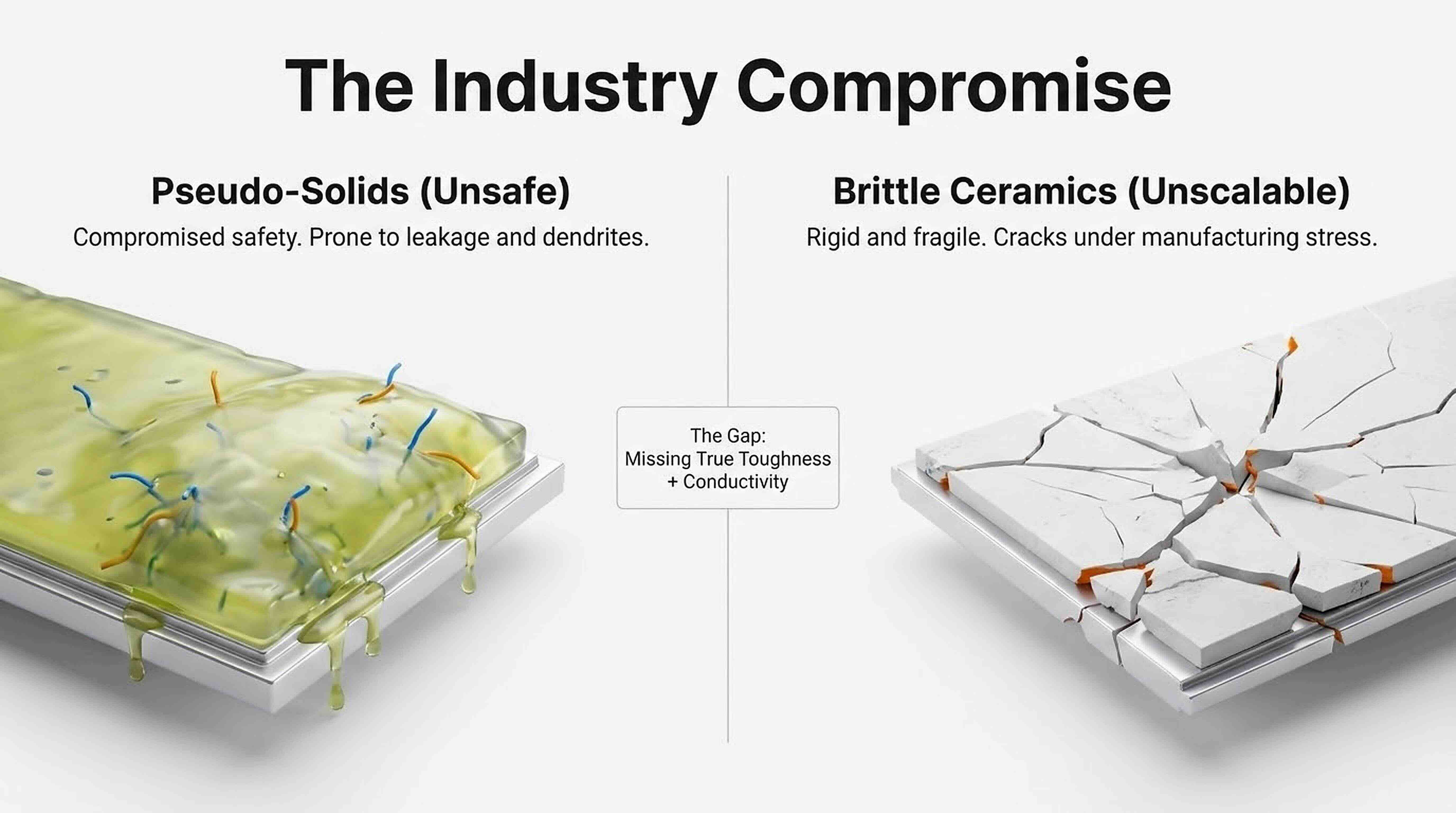
"The industry has been forced to choose between the flexibility of polymers and the conductivity of ceramics — until now."
The SoliMind Breakthrough: Interfacial Engineering
SoliMind Gen 1 represents a paradigm shift from a passive mixture to an integrated molecular architecture. We have moved beyond simple blending to advanced Interfacial Engineering, utilizing a dynamic cross-linking network that binds the ceramic and polymer phases into a single, high-speed transport highway.
This breakthrough does more than just connect materials; it fundamentally "greases the wheels" for lithium-ion movement. By optimizing the electrostatic potential across the network, we have significantly reduced the binding energy of lithium ions. Rather than being "anchored" or slowed down by the polymer chains, the ions move through the Gen 1 electrolyte with unprecedented fluidity. This is not just a separator; it is an active, self-correcting network designed for high-power demands.
Exceptional Properties: Flexibility Meets Resilience
By solving the interface problem, the Gen 1 platform achieves a suite of mechanical and thermal properties that redefine the standard for solid-state durability.
Supertough Flexibility
Unlike brittle ceramics, the Gen 1 electrolyte demonstrates an elongation at break of approximately 205%. This extreme flexibility allows for seamless integration into high-volume manufacturing lines, supporting the bending and rolling required for modern cell formats without any risk of fracture or micro-cracking.
Self-Healing Capability
The electrolyte features "dynamic reversibility" at the molecular level. This enables a self-healing capability where the internal bonding network can autonomously repair itself if subjected to mechanical damage. This ensures the structural and electrochemical integrity of the battery remains intact throughout the rigors of real-world use.
Thermal Robustness and Dimensional Stability
Safety is a core pillar of our technology. While standard separators and gels show obvious shrinkage and deformation at 200°C, SoliMind Gen 1 maintains its dimensions and structural integrity. This high-temperature stability ensures a safe operating envelope even under extreme thermal abuse.
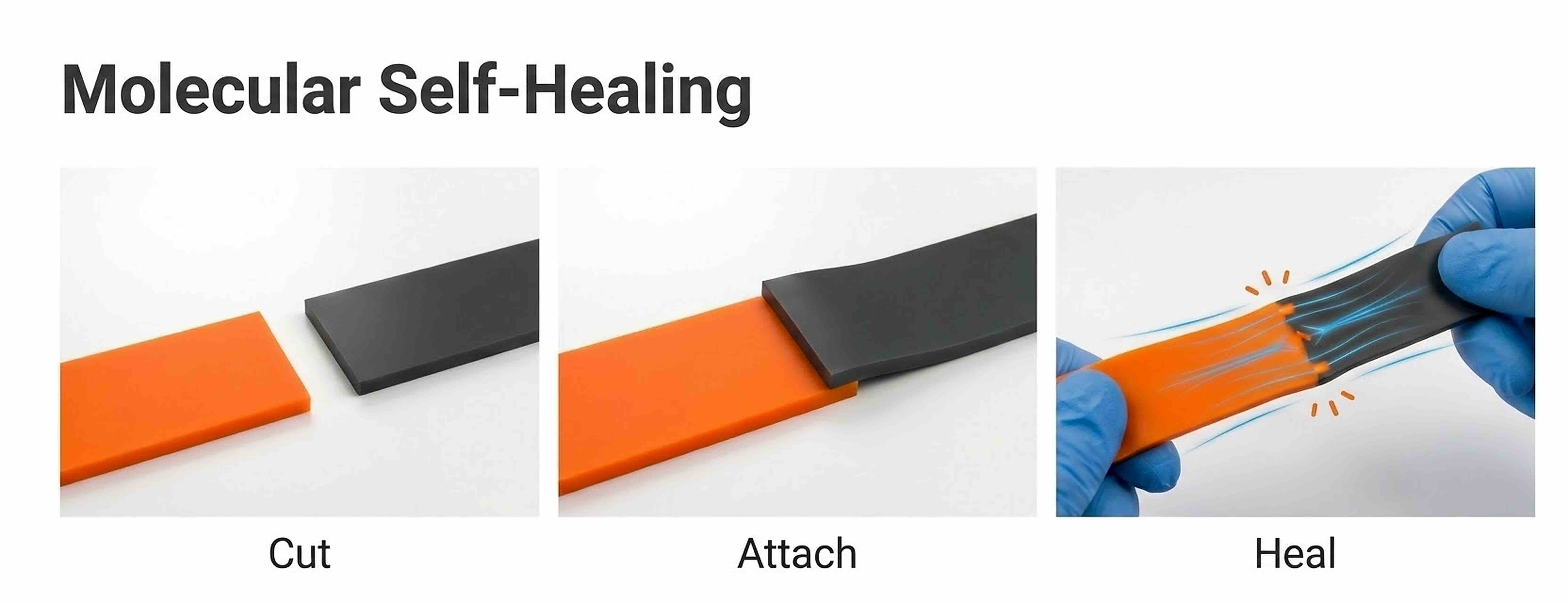
Note: The orange and black colors used in this specific illustration are for dye-tracing purposes only. These colors help researchers and users visually track the movement of the healing agents within the material. They do not represent the actual physical color of SoliMind’s Gen1 Electrolyte in its production state.
Why This Matters
Manufacturability: Thin, compliant electrolyte films are what make roll-to-roll processing and wound/rolled architectures realistic. Solid-state manufacturing literature highlights the need for thin, robust electrolytes and scalable processing routes.
Safety without hype: Even “nonflammable” electrolytes can underperform in battery-level safety if their chemistry reacts aggressively with charged electrodes. That’s why we frame benefits as reduced volatile-liquid dependence and emphasize full-cell validation.
Energy density pathway: Because of our 4.84 V electrochemical window, Gen 1 is uniquely suited for high-nickel (NMC) cathode families. This enables us to target the industry-leading energy density benchmarks
4.36 V (PP separator)
0.162 mS/cm (PP separator)
Uneven / Dendrite growth (PP separator)
Conclusion: A New Standard for "Truly Solid"
At SoliMind, we have proven that the industry no longer needs to accept a trade-off between safety, manufacturability, and high-performance energy density. By engineering the interfaces at a molecular level, we have moved past the era of brittle ceramics and compromised gels.
SoliMind Gen 1 Solid Eletrolyte is the new standard for a truly solid-state future: fast, tough, and ready for the mass market.