


Solid-state batteries promise a step-change in energy density, safety, and performance—but they also change what “good battery management” means. A Battery Management System (BMS) designed for traditional lithium-ion packs was built around a simple assumption: if you can measure voltage, current, and surface temperature, you can infer most of what matters inside the cell.
That assumption breaks down with solid-state.
At SoliMind, we treat the BMS as part of the battery product from day one—because the chemistry and physics of solid-state introduce new internal states, new risks, and new integration requirements for OEMs. The result is a BMS that isn’t just a monitoring box; it’s an observability and safety layer designed specifically for solid-state behavior.
The Blind Spots of Legacy BMS
Most legacy BMS architectures focus on three signals:
- voltage
- current
- surface temperature
This works reasonably well for conventional Li-ion packs because many internal conditions can be approximated from those signals using well-understood models. In practice, the BMS can estimate SoC/SoH, enforce voltage and thermal limits, and keep the pack operating safely.
Solid-state batteries are different.
Solid-state performance and safety depend strongly on internal mechanical states that a legacy BMS cannot see:
- pressure
- force
- stress and strain distributions
These mechanical states influence interface stability and conduction pathways inside the cell. If you don’t observe them, you’re forced to operate with large safety margins—or you learn about problems only after the pack has already degraded or failed.
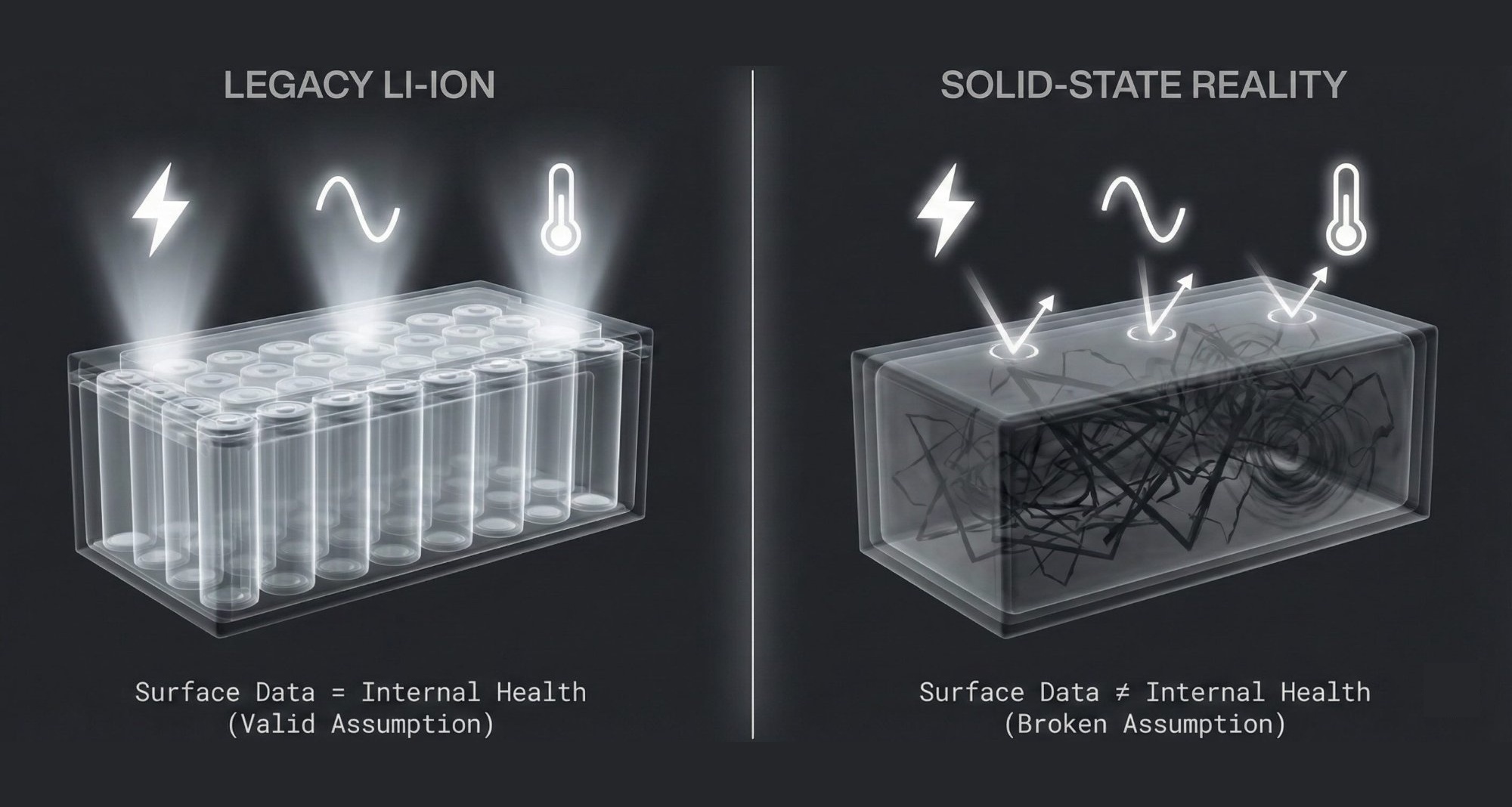
A Step-Change in Chemistry Requires a Step-Change in Management
New Failure Modes and Risks in Solid-State
Solid-state batteries introduce a different risk landscape. Even when the battery looks “fine” from voltage/current/temperature readings, the internal dynamics can be moving toward a failure mode that traditional BMS logic isn’t designed to detect early.
Some key risks include:
Non-uniform lithium deposition: If lithium transport or current density becomes non-uniform, you can develop localized regions of accelerated degradation or instability. This isn’t simply “a voltage issue”—it’s often an interface and mechanical uniformity problem.
Void formation (impedance jumps): During cycling, voids can form at interfaces. This can cause sudden impedance growth, power capability drops, and heat generation increases. A legacy BMS may only notice after the system’s performance has already been impacted.
Dendrite/filament penetration: Depending on materials and conditions, dendritic or filamentary growth can occur. Avoiding the regimes where this risk increases requires more than fixed current limits—it often depends on the combined effect of temperature, pressure, and load history.
Critical Current Density (CCD) depends on pressure + temperature history: This is one of the most important solid-state realities: the safe operating current isn’t just a static spec. CCD limits can depend on pressure and temperature history, meaning the “old logic” of fixed thresholds can fail—especially when the pack is aging or operating across broad environmental conditions.
Embedded Sensor Layer: Making Solid-State Observable
This is why we’re building a BMS that is tightly coupled to solid-state cell design—not bolted on later.
In SoliMind, an embedded sensor layer is added in the electrolyte during manufacturing, designed to directly measure internal states that conventional packs can’t expose.
What this enables
Instead of relying on indirect inference alone, embedded sensing can measure:
- internal strain
- temperature gradients
- interface health proxies
This transforms the BMS from “monitor and protect” into “measure, predict, and prevent.”
The Business Case: Predictability Drives Adoption
For OEMs, adopting a new chemistry isn’t just about energy density. It’s about risk:
- Can the system be qualified and certified?
- Can performance be predicted across temperature and aging?
- Can failures be diagnosed and attributed clearly?
- Can safety margins be guaranteed without killing performance?
Legacy BMS architectures were not built for a world where mechanical and interfacial states are first-class drivers of battery behavior. Without new observability, OEMs either take on high integration risk or operate so conservatively that they lose much of the benefit of solid-state.
An embedded-sensor solid-state BMS changes that equation:
- Predictability = Adoption
- OEMs get diagnosability
- OEMs get guaranteed safety margins that are grounded in real internal state, not guesswork
Closing: "BMS Re-Invented" Isn't a Feature - It's a Requirement
Solid-state batteries don’t just need a better version of yesterday’s BMS. They need a BMS that matches their physics:
- mechanical state matters
- interfaces matter
- CCD depends on history, not just a spec sheet
- observability is the difference between “lab performance” and “field reliability”
By designing the BMS from day one—alongside the battery architecture and embedded sensing—we’re building the layer that makes solid-state not only high-performance, but also integrable, diagnosable, and adoptable at scale.